If you’ve ever walked the floor of a metal fabrication shop, you’ve probably seen furnaces of all shapes and sizes: box furnaces for tempering small parts, conveyor furnaces for continuous annealing of wire, even the bright orange, naturally aspirated units for stress relieving large steel castings. If you’re a metals engineer or production manager, though, you’ve likely also heard a persistent question that comes up when quality, consistency, and material performance are non-negotiable: can a vacuum furnace be used for heat treatment of metals? Vacuum Furnace
As someone who’s spent the last 12 years selling, installing, and supporting vacuum furnaces for metal processors across North America, the answer I give isn’t a simple yes or no—it’s a nuanced, “yes, and for many applications, it’s the only way to get the results you need, without the downsides of traditional atmospheric furnaces.” Let’s break this down, because for every customer who tells me they’ve been happy with their air-fired furnace for decades, there’s another one dealing with burnt parts, inconsistent surface hardness, or expensive post-processing that a vacuum furnace solves entirely.
First, let’s get back to basics: what is vacuum heat treatment, and how does it differ from the way most heat treatment is done today? Traditional furnaces operate with an atmosphere inside: sometimes they’re flooded with nitrogen, argon, or even endothermic gas (a mix of hydrogen, nitrogen, and carbon monoxide designed to prevent oxidation), but they’re never fully evacuated. A vacuum furnace, by contrast, removes 99.9% of the air and residual gases from its chamber before heating, then can be backfilled with inert gas for quenching, or held under high vacuum for processes that require no external gas at all. That single difference changes everything for metal parts.
Let’s start with the biggest pain point for any heat treater: surface contamination. When you heat a metal part in open air, even at temperatures as low as 400°C, oxygen and nitrogen in the air react with the part’s surface. For steel, this means a thin layer of iron oxide (scale) forms. For stainless steels or titanium, it means a hardened, brittle layer of nitrides and carbides that not only ruins the smooth finish of a precision part but also makes it prone to cracking in service. A few years ago, a client in the aerospace industry brought us a batch of turbine blades they’d run through their regular batch furnace. The blades were supposed to have a polished, aerodynamic surface, but they came out with heavy scale and had to be sent out for grinding and blasting, adding $12 per part and a week of lead time. When we ran a test of the same batch in one of our oil-sealed vacuum furnaces, there was no scale at all. The only post-processing they needed was a light polish to remove any handling marks, cutting their production time by 60% and saving them over $18,000 for that 1,500-part run. That’s the kind of concrete result that makes the shift to vacuum furnaces worth it, even if the upfront cost is higher than a standard furnace.
But vacuum furnaces aren’t just good for reducing surface contamination—they enable processes that are either impossible or extremely inefficient in atmospheric furnaces. Take vacuum carburizing, for example, a process used to harden the surface of low-carbon steel parts like gears, bolts, and camshafts. Traditional carburizing uses endothermic gas or liquid carburizers that can leave inconsistent carbon content across the part, especially in complex geometries with holes or sharp corners. With vacuum carburizing, you control the carbon content precisely by injecting small amounts of acetylene or natural gas into the vacuum chamber in controlled pulses, rather than flooding the entire chamber. Last year, I worked with a automotive parts supplier that was struggling with gear teeth that wore out 30% faster than their customers’ specifications required. They switched to a vacuum furnace for carburizing, and the carbon gradient across each gear was accurate to within 0.05% of the target, which increased wear resistance by 45%—enough to earn them a 3-year contract with a major truck manufacturer. That’s the kind of performance that can make a vacuum furnace a competitive advantage, not just a piece of equipment.
Another common misconception is that vacuum furnaces are only for high-end, exotic metals like titanium or superalloys. That’s simply not true. They work for every common heat treatable metal: carbon steels, alloy steels, stainless steels, aluminum, copper, even brass. For example, annealing copper wire— a process to soften it for drawing into thinner gauges. If you anneal copper in air, it oxidizes so badly that you have to use expensive protective coatings or clean it afterward, which adds time and cost. In a vacuum furnace, copper comes out bright, clean, and ready to draw without any post-processing. We’ve had customers in the wire industry replace their entire fleet of atmospheric annealing furnaces with two of our horizontal vacuum furnaces, cutting their annual operating costs by over $40,000 just from eliminated cleaning and material waste.
Of course, vacuum furnaces aren’t perfect for every job. If you’re heat treating low-carbon steel parts that don’t require a precise surface finish or uniform hardness, and you’re only running small batches, a standard atmospheric furnace might be more cost-effective in the short term. The upfront investment in a vacuum furnace— typically ranging from $50,000 for a small tabletop unit to over $500,000 for a large, high-temperature batch furnace— is a big barrier for many small to medium businesses. That’s why I always start a conversation with a new customer by asking them about two things: their current production costs and their quality requirements. If they’re spending a lot on post-processing to fix contaminated parts, or if their parts are failing in the field due to inconsistent heat treatment, the vacuum furnace almost always pays for itself within 2-3 years.
I also talk to customers about the different types of vacuum furnaces, because one size doesn’t fit all. There’s the batch vacuum furnace, which is great for small to medium runs of a variety of parts; continuous vacuum furnaces, which are designed for high-volume, steady production lines; and high-temperature vacuum furnaces, which can reach temperatures up to 2,400°C for processes like sintering or annealing tungsten. A customer making small, high-volume fasteners will have very different needs than a job shop that runs a mix of 100 different part types each month, and matching the right furnace to their process is half the battle.
One of the most important advantages of vacuum furnaces that people don’t talk about much is their environmental footprint. Traditional atmospheric furnaces burn fuel (natural gas, propane) to heat the chamber, and they vent byproducts like carbon monoxide, nitrogen oxides, and volatile organic compounds into the atmosphere. Vacuum furnaces use electric heating elements (most of our units are powered by 480V three-phase power) and don’t require fuel combustion, so their emissions are almost zero. For manufacturers operating in areas with strict air quality regulations, this is a huge benefit— many of our customers in California and the Pacific Northwest have been able to avoid expensive air permits by switching to vacuum furnaces. They also reduce waste: no more scrapping parts due to scale or inconsistent hardness, no more chemicals used for cleaning, no more water waste from quench tanks that have to be treated to remove contaminants. A customer in Oregon recently told us that switching to a vacuum furnace cut their annual water usage by 75% and reduced their waste hauling costs by $12,000 a year, on top of their production savings.
I also want to address a common concern: downtime and maintenance. A lot of people think that because vacuum furnaces have moving parts like pumps and valves, they break down more often than atmospheric furnaces. In my experience, that’s not the case— as long as you follow a regular maintenance schedule. Our furnaces come with 24/7 remote monitoring, so we can catch small issues like a slow vacuum pump or a worn seal before they cause downtime. We also offer on-site service across the U.S., and our average downtime for a furnace under our service contract is less than 8 hours a year. That’s comparable to or better than many mid-sized atmospheric furnaces, which often require annual tune-ups and can break down for days if their burners or control systems fail.
Over the past 12 years, I’ve seen a lot of customers make the switch to vacuum furnaces, and the feedback is consistent: it’s not just about getting a better heat treatment, it’s about reducing costs, improving quality, and being able to take on new, higher-value work. A few years ago, we installed a large vacuum furnace at a job shop in Michigan that had never done aerospace parts before. Within a year, they were supplying small titanium components to two local aerospace suppliers, work they couldn’t have done with their old atmospheric furnace because of the strict finish and hardness requirements. That’s the kind of growth a vacuum furnace can unlock.
So to answer the original question: yes, a vacuum furnace absolutely can be used for heat treatment of metals, and for an increasing number of applications, it’s the best, most cost-effective option available. It’s not a one-size-fits-all solution, but it’s no longer the specialized, high-end piece of equipment it was 20 years ago. Modern vacuum furnaces are reliable, easy to operate, and flexible enough to handle everything from small batch job shop work to high-volume production lines.
If you’re tired of scrapping parts due to oxidation, dealing with post-processing costs, or struggling to meet tight quality specifications, a vacuum furnace might be the solution you’ve been looking for. There’s no one-size-fits-all furnace for every application, so let’s talk about your specific needs— part types, production volumes, quality targets, and budget— and we can help you figure out if a vacuum furnace is the right fit for your operation. Reach out to discuss your requirements, and we’ll provide a custom quote and a detailed breakdown of how a vacuum furnace can impact your bottom line.
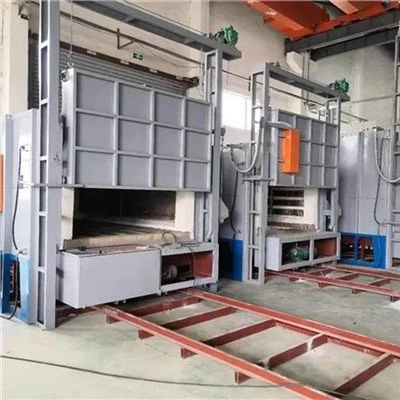
Car-Bottom Forging Furnace References
ASM International. (2015). Vacuum Heat Treating: Principles and Applications. ASM Handbook Volume 4: Heat Treating.
Davis, J. R. (Ed.). (1993). Heat Treater’s Guide: Practices and Procedures for Irons and Steels. ASM International.
Tosi, M. (2020). Environmental and Economic Benefits of Vacuum Heat Treatment for Metal Fabrication. Journal of Manufacturing Processes, 56, 1212-1220.
Danyang Dingfeng Industrial Furnace Co., Ltd.
Danyang Dingfeng Industrial Furnace Co., Ltd. is one of the most experienced vacuum furnace manufacturers and suppliers in China, also supports customized service with low price. Please feel free to wholesale high quality vacuum furnace made in China here from our factory. For pricelist, contact us now.
Address: Lizhuang Economic Development Zone, Danyang City
E-mail: saleszk@dffurnace.com
WebSite: https://www.dffurnace.com/
